

Please enter your Email Address below to be sent an email to Reset your Password
Please enter your Email Address below to be sent an email to Reset your Password
Categories
Filter Products
No Filters Available
Your Basket
Your Basket is Empty

Search our Website:

Free Next Day Delivery
on orders over £100 before 2PM

Over 5000+ Products
in our stock range

Family Owned Business
established 10+ years

Discounts Available
on 100's of products
Posted: 02 November 2026
Posted: 2 November 2026
Electric panel heaters are slim, quick to warm up and easy to fit, which makes them a popular choice for bedrooms, home offices, extensions, hallways and rooms that aren’t served by central heating. But with so many wattages, controls and features on offer, it isn’t always obvious which one to buy. This guide explains how panel heaters work, how to choose the right size, and what to check before you order. If you’d like to see the wider range first, you can browse all of our electric heaters.
An electric panel heater, often called a panel convector heater, is a slim, flat heater that mounts on a wall or sits on feet. Cool air enters near the bottom, passes over a heated element and flows out of the top, and this circulation of warm air gradually heats the room. Because there is very little to heat up before warm air is produced, panel heaters respond quickly.
They are generally lighter and cheaper than heaters with a heat-retaining core, and the slim profile makes them easy to place in tight spaces. The trade-off is that they stop giving off heat fairly soon after switching off, so they work best with a thermostat and timer that keep the room at a steady temperature. You can see our range of panel convector heaters online.
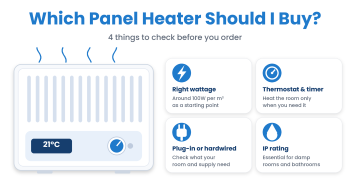
Choosing the right size is one of the most important decisions. A heater that is too small will struggle to warm the room, while one that is too large wastes money and may cycle on and off. As a rough guide, many people allow around 100W per square metre in a reasonably well-insulated room.
| Room size (approx.) | Rough starting wattage |
|---|---|
| 5 m² | 500W |
| 10 m² | 1000W (1kW) |
| 15 m² | 1500W (1.5kW) |
| 20 m² | 2000W (2kW) |
To work out your room size, multiply its length by its width in metres. Treat the table as a starting point only. Rooms with poor insulation, large windows, high ceilings or draughts need more heat, while well-insulated rooms may need less. If you’re unsure, ask a heating professional or electrician to calculate it. For a large room, two heaters can sometimes heat more evenly than one large one.
Some panel heaters have a plug and can be used from a standard socket, while many wall-mounted heaters are designed to be hardwired to a fused connection. Which one you need depends on the product, its wattage and the position of your supply, so check the specification before you buy. Hardwired heaters should be installed by a competent electrical professional, particularly for new circuits, higher wattages or bathrooms and other damp areas.
Lot 20 is the common name for the Ecodesign rules for local space heaters (Commission Regulation (EU) 2015/1188). They cover electric heaters such as panel heaters, electric radiators, storage heaters and electric fires, and they apply to products placed on the market from 1 January 2018. The rules remain in force in Great Britain after Brexit, while Northern Ireland continues to follow the EU version. The aim is to reduce wasted energy by setting minimum efficiency requirements and making sure heaters have better controls.
In practice, this is why a modern electric panel heater typically comes with an electronic thermostat and a programmable timer, and why many also include extras such as open-window detection or adaptive start. These controls help the heater run only when it’s needed, so you don’t pay to heat an empty or already-warm room.
When you’re comparing heaters, here’s what to look for:
Lot 20 compliance doesn’t mean one heater will always be cheaper to run than another, because your wattage, insulation and how you use the heater still matter most. But good built-in controls make it easier to avoid wasting energy.
The IP rating tells you how well a heater is protected against water and dust. For bathrooms, wet rooms and other damp areas, you’ll need a heater with a suitable IP rating, and its position in the room also matters. Don’t assume that a heater is suitable for a bathroom unless the specification says so, and ask your electrician to confirm the right product and location.
Always follow the manufacturer’s instructions on mounting height and clearances, never cover a heater that’s switched on, and don’t dry washing on a heater unless it is designed for that purpose. If you’re fitting a hardwired heater, or one in a bathroom, use a qualified electrician.
For most buyers, the right panel heater comes down to a handful of choices: the right wattage for the room, a good thermostat and timer, the right type of connection and, in damp rooms, a suitable IP rating. Take your time to measure the room and check the specification, and you’ll end up with a heater that warms the space quickly and efficiently. When you’re ready to compare options, browse our panel convector heaters or see our full heaters range.
Fixed electric heaters should be selected, installed and tested by a competent electrical professional where required. Requirements depend on the individual installation and the applicable edition of BS 7671.