

Please enter your Email Address below to be sent an email to Reset your Password
Please enter your Email Address below to be sent an email to Reset your Password
Categories
Filter Products
No Filters Available
Your Basket
Your Basket is Empty

Search our Website:

Free Next Day Delivery
on orders over £100 before 2PM

Over 5000+ Products
in our stock range

Family Owned Business
established 10+ years

Discounts Available
on 100's of products
Posted: 02 November 2026
Posted: 2 November 2026
Electric heating is flexible, easy to fit and doesn’t need a boiler or pipework, which is why it’s popular for extensions, home offices, bedrooms, garages and whole-home setups. But when you start shopping, two options come up again and again: panel heaters and electric radiators. They can look similar on the wall, but they heat a room in different ways. This guide explains the differences, how they compare on running costs, and what to check before you buy. If you’d like to see everything in one place, you can browse our full range of electric heaters.
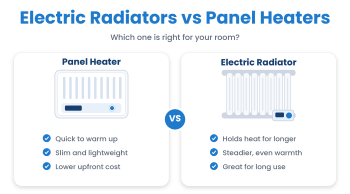
Panel heaters warm up quickly and are slim and affordable, which makes them a good fit for rooms you use for short periods. Electric radiators take longer to warm up but hold their heat for longer, which suits rooms you use for hours at a time. Neither is better in every situation.
| Feature | Panel heater | Electric radiator |
|---|---|---|
| How it heats | Warms the air as it passes over a heated element (convection) | Heats a body, such as a fluid or ceramic core, which gives off heat |
| Warm-up time | Quick | Slower |
| Heat once switched off | Cools down fairly quickly | Keeps giving off heat for longer |
| Upfront cost | Usually lower | Usually higher |
| Look and size | Slim and lightweight | Often heavier and bulkier, so check wall fixings |
| Best suited to | Rooms used for short periods, or as a budget-friendly option | Rooms used for long periods, such as living rooms and bedrooms |
A panel heater, often called a panel convector heater, is a slim, wall-mounted unit that warms the air in the room. Cooler air enters at the bottom, passes over a heated element and rises out of the top, and this circulation gradually warms the room.
Because there’s very little to heat up before warm air is produced, panel heaters are quick to respond. They are also slim, light and generally cheaper to buy than electric radiators. The trade-off is that they stop giving off heat soon after they switch off, so a room can cool down faster once the thermostat is satisfied.
Most panel heaters come with a thermostat, and many have a timer, so you can heat the room only when you need to. You can see our range of panel convector heaters online.
An electric radiator contains a heated core, which might be a fluid, a ceramic material or another heat-retaining body. The element warms the core, and the core then releases heat into the room. Because the core holds heat, an electric radiator takes longer to warm up but carries on giving off heat for a while after the element switches off, which many people find gives a steadier, more even warmth.
Electric radiators usually cost more upfront than panel heaters, and they can be heavier and thicker, so it’s worth checking your wall can carry the weight. Many come with programmable timers and thermostats, and some offer smart or app controls. Take a look at our electric radiators to compare styles and sizes.
This is the question most people ask, and the honest answer is that the difference is often smaller than you might expect. An electric heater turns the electricity it uses into heat in the room, so a 1kW heater running for an hour uses 1kWh whether it’s a panel heater or an electric radiator. What changes your bill is how the heater is used:
In short, choose the heater that matches how you’ll use the room, and use its controls properly. Check the current price you pay per unit of electricity with your supplier to estimate your costs.
As a very rough guide, many people allow around 100W of heating per square metre in a reasonably well-insulated room. Poorly insulated rooms, rooms with large windows, high ceilings or draughts need more. Measure your room, allow for how well it is insulated and how warm you like it, and check the heater’s wattage against this. If you’re unsure, ask a heating professional to calculate it.
Plug-in heaters need little more than a socket, but many wall-mounted heaters are hardwired and should be fitted by a qualified electrician. This is especially important for higher-wattage heaters, new circuits and any heater going in a bathroom or other damp area. Always follow the manufacturer’s instructions on mounting height and clearances, never cover a heater that’s switched on, and don’t dry washing directly on a heater unless it is designed for that purpose.
Panel heaters are quick, slim and affordable, so they suit rooms you heat for short periods. Electric radiators cost more and take longer to warm up, but hold their heat for longer, so they suit rooms you use for hours at a time. Neither is automatically cheaper to run, so match the heater to the way you’ll use the room, size it properly and make good use of the thermostat and timer. When you’re ready to compare options, browse our panel convector heaters, our electric radiators or our full heaters range.
Fixed electric heaters should be selected, installed and tested by a competent electrical professional where required. Requirements depend on the individual installation and the applicable edition of BS 7671.