

Please enter your Email Address below to be sent an email to Reset your Password
Please enter your Email Address below to be sent an email to Reset your Password
Categories
Filter Products
No Filters Available
Your Basket
Your Basket is Empty

Search our Website:

Free Next Day Delivery
on orders over £100 before 2PM

Over 5000+ Products
in our stock range

Family Owned Business
established 10+ years

Discounts Available
on 100's of products
Posted: 23 October 2026
Posted: 23 October 2026
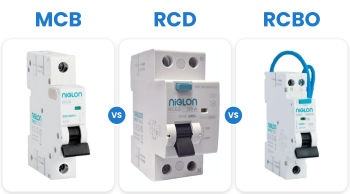
If you’re shopping for a consumer unit or replacement protective devices, you’ll quickly run into three similar-sounding terms: MCB, RCD and RCBO. They sit side by side in your fuse box and look alike, but they protect against different things. This guide explains what each one does, how they differ, how to choose the right product, and what UK buyers should check before they order.
An MCB protects a circuit against overloads and short circuits. An RCD protects people against electric shock and some fire risks by detecting earth leakage. An RCBO combines both jobs in a single device for one circuit.
| Device | Full name | Protects against | Does not protect against |
|---|---|---|---|
| MCB | Miniature Circuit Breaker | Overloads and short circuits | Earth leakage and shock |
| RCD | Residual Current Device | Earth leakage faults and electric shock | Overloads and short circuits (needs an MCB or fuse alongside it) |
| RCBO | Residual Current Breaker with Overcurrent protection | Overloads, short circuits and earth leakage faults | Voltage surges (that’s the job of an SPD) and arc faults (that’s the job of an AFDD) |
An MCB is an automatic switch that cuts the power when a circuit draws too much current. That might be an overload, such as too many appliances on one circuit, or a short circuit, where current takes a path it shouldn’t. It protects the cable and the circuit from overheating.
What an MCB doesn’t do is detect a small current leaking to earth, such as someone touching a live part. That current can be too small to trip an MCB but still dangerous, which is why an MCB on its own is not enough in a modern home.
MCBs are rated in amps (for example 6A for lighting or 32A for a ring final circuit) and come in different trip curves, commonly B and C. The right rating depends on the circuit and the cable, so it’s something to confirm with your electrician.
Looking for MCBs? Choose by range: Niglon Protego MCBs, Live MCBs for SRN boards and Crabtree Starbreaker MCBs.
An RCD constantly compares the current going out on the live conductor with the current coming back on the neutral. If some of it is escaping elsewhere, for example through a person or a damaged appliance, the RCD detects the difference and disconnects the supply very quickly. Domestic RCDs are typically rated at 30mA, which is designed to reduce the risk of serious electric shock.
A standalone RCD does not protect against overloads or short circuits, so it works together with MCBs (or fuses). In a dual RCD consumer unit, two RCDs each protect a group of circuits, with an MCB on every circuit. If you need a standalone RCD, see our Niglon 63A 30mA double pole Type A RCD or our Click Elucian 2-pole 100A 30mA RCD.
Look for the RCD type too. Type A is a common choice for modern homes, where electronic equipment such as LED lighting, chargers and computers can produce leakage current that Type A is designed to handle. Other types exist for specific applications, so check the specification rather than assuming.
An RCBO does the job of an MCB and an RCD in one device. Because each circuit has its own RCBO, a fault on one circuit only switches off that circuit. Your lights stay on if the oven trips, and it’s easier to see which circuit has the problem.
The trade-off is cost. RCBOs are more expensive than MCBs, and a full RCBO board costs more than a dual RCD board. Many buyers feel the convenience and fault-finding benefits are worth it.
You can shop RCBOs by range: Niglon Protego RCBOs, Live RCBOs for SRN boards and Crabtree Starbreaker RCBOs.
On a dual RCD board, a fault on one circuit can trip the RCD and take out every circuit in that group. On an RCBO board, only the faulty circuit trips. For most modern homes, an all-RCBO board is the more convenient setup, while a dual RCD board remains the lower-cost route for straightforward installations. Your electrician can advise which suits your property.
Start with what you’re trying to do, then match the device to it.
RCDs and RCBOs have a test button. It’s recommended that you press it regularly, roughly every three months, to check the device trips. If it doesn’t trip, contact an electrician.
MCBs protect against overloads and short circuits. RCDs protect against earth leakage and shock. RCBOs do both on a single circuit. For many modern homes, an RCBO board is the convenient choice, while a dual RCD board is the lower-cost alternative. Whichever you pick, check compatibility, current rating, trip curve, RCD type and spare ways before you order, and have the work done and tested by a competent professional.
Consumer units and protective devices should be selected, installed and tested by a competent electrical professional. Requirements depend on the individual installation and the applicable edition of BS 7671.