

Please enter your Email Address below to be sent an email to Reset your Password
Please enter your Email Address below to be sent an email to Reset your Password
Categories
Filter Products
No Filters Available
Your Basket
Your Basket is Empty

Search our Website:

Free Next Day Delivery
on orders over £100 before 2PM

Over 5000+ Products
in our stock range

Family Owned Business
established 10+ years

Discounts Available
on 100's of products
Posted: 12 October 2026
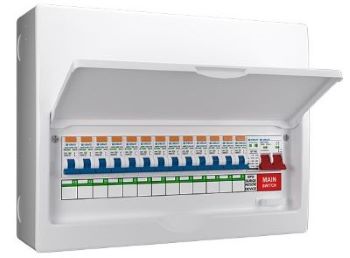
Order Electrical – Consumer Unit Buyer's Guide
A consumer unit (often still called a fuse box or fuse board) is where your property's electricity supply is split into separate circuits and protected. When you start shopping, you'll meet terms like RCBO, dual RCD, SPD and AFDD, and it isn't obvious which you need. This guide explains what each one does and how to choose.
It supplies and protects the circuits in your property, such as lighting, sockets, cooker, shower, heating, garage, outdoor supplies and EV charger. Each circuit has its own protective device. If something goes wrong, that device disconnects the circuit to reduce the risk of shock or fire.
|
Device |
What it does |
In plain English |
|---|---|---|
|
RCBO |
Protects against overloads, short circuits and earth leakage faults |
Protects each individual circuit |
|
SPD (surge protection) |
Protects against short voltage surges |
Helps protect TVs, computers, appliances and other electronics |
|
AFDD |
Detects dangerous electrical arcing |
Extra protection against electrical fires |
These do different jobs, so one is not a substitute for another. A single consumer unit can contain all three.
An RCBO protects one circuit against overloads, short circuits and earth leakage faults. Because every circuit has its own, a fault on one circuit only switches off that circuit. Your lights stay on if the oven trips, and the faulty circuit is easier to identify.
Two terms to look for when comparing:
You may also see cheaper consumer units described as dual RCD. These split the circuits into two groups, each protected by one RCD, with a smaller breaker (MCB) on each circuit.
The difference shows up when a fault occurs. On a dual RCD board, a fault can trip the RCD and switch off every circuit in that group. On an RCBO board, only the faulty circuit goes off. RCBO boards usually cost more, but many buyers find the convenience worth it, and it makes fault-finding simpler.
An SPD guards against sudden voltage spikes that can damage electronic equipment. Homes now hold a lot of electronics, including TVs, computers, broadband equipment, smart-home devices, heating controls, security systems and EV chargers. An SPD usually adds a modest amount to the cost of a new consumer unit, so many buyers consider it worthwhile. Whether one is required should be decided by your electrician under the current Wiring Regulations.
An AFDD monitors the electrical waveform and disconnects the circuit if it detects the signature of a dangerous arc. Arcing can come from damaged cables, deteriorated insulation or loose connections, and in some circumstances it can start a fire.
Current regulations call for AFDDs on certain circuits in particular types of higher-risk residential premises, and recommend them more widely. In most ordinary homes outside those requirements they aren't normally fitted on every circuit. They are also more sophisticated devices and cost significantly more than a standard RCBO, so fitting several can add a lot to the price of a unit. Your electrician can tell you whether they're needed or worth considering for your property.
|
Option |
Protection included |
Best suited to |
Things to consider |
|---|---|---|---|
|
Dual RCD board |
MCBs with two RCDs |
Straightforward installations where budget is the priority |
A fault can switch off a whole group of circuits |
|
RCBO board |
Individual RCBO on each circuit |
Most modern homes |
Higher cost than dual RCD, but better circuit separation |
|
RCBO board + SPD |
RCBOs plus surge protection |
Homes with a lot of electronics, smart devices or an EV charger |
A very common specification for a modern home |
|
RCBOs + SPD + AFDDs |
Overload, leakage, surge and arc-fault protection |
Premises where AFDDs are required, or where extra fire protection is wanted |
Significantly more expensive, especially with several AFDDs |
Count the circuits you need today, such as lighting, sockets, cooker, shower, heating, garage, outdoor supply and EV charger, then add some spare ways for the future. Check how many usable ways the unit offers once any main switch or SPD has taken its space, since some devices take up more than one slot. A slightly larger unit usually costs less than replacing a full one later.
RCBOs protect the circuit, SPDs protect against surges and AFDDs detect arcing. For many modern homes, Type A RCBOs with surge protection is a good starting point to discuss with your electrician. When comparing units, check which devices are included, whether the RCBOs are Type A and bi-directional, whether an SPD is included, whether AFDDs are required, and how many spare ways you get.
Consumer units and protective devices should be selected, installed and tested by a competent electrical professional. Requirements depend on the individual installation and the applicable edition of BS 7671.